We compared nine months of streaming reports with the royalty statements and payments for our catalog.
The same stream count did not always produce the same amount of money. The effective rate changed between platforms, countries, and reporting months. The payment also arrived weeks after the streams appeared in the artist dashboards.
That is why a calculator based on one fixed rate can only give a rough guess.
Streaming services do not use one fixed rate
Most public calculators use a simple formula:
streams × average rate = estimated revenueThe arithmetic is easy. The assumption is the problem.
Major streaming services do not promise one fixed payment for every stream. Spotify, for example, pays rights holders from royalty pools based on their share of eligible streams in each market. The size of those pools depends on subscription and advertising revenue. The artist is then paid according to the agreement with the label or distributor.
Spotify explains the streamshare model directly.
The effective amount behind one stream can therefore change with:
- the streaming service;
- the listener’s country;
- whether the revenue came from subscriptions or advertising;
- the month in which the activity was reported;
- the rights included in the payment;
- the distributor’s fees and reporting rules.
In our own reports, Spotify’s effective rate moved by roughly 20% over nine months. Our audience and stream volume changed during the same period. The reports show the movement, but they do not prove that one factor caused it.
The useful conclusion is narrower: one historical average cannot reliably predict every future month.
Streams and payments appear at different times
A streaming dashboard may show activity within days. A royalty statement usually arrives much later.
The path looks more like this:
listener plays a track
        ↓
streaming service closes the reporting month
        ↓
service sends a report to the distributor
        ↓
distributor processes the statement
        ↓
money appears in the artist's account
In one part of our catalog, the first payment appeared 49 days after the first recorded stream. Later statements followed a similar delay of roughly two reporting months. That is our experience with one catalog and distributor, not a universal schedule.
The delay matters when an artist is planning cash flow. Streams earned in March may not help pay a March bill.
We matched three kinds of records
To understand what the catalog earned, we compared:
- stream counts from the artist dashboards;
- royalty statements from the distributor;
- the dates and amounts of payments received.
The reports did not always use the same names, dates, or groupings. A platform could report streams by listening month while the distributor grouped the related royalties into a later statement. Some services appeared as several revenue lines.
Matching these records was more useful than looking at a streaming screenshot alone. It showed which activity had been reported, which money had arrived, and which period was still incomplete.
What the calculator does
We built howmuchperstream.com around three questions.
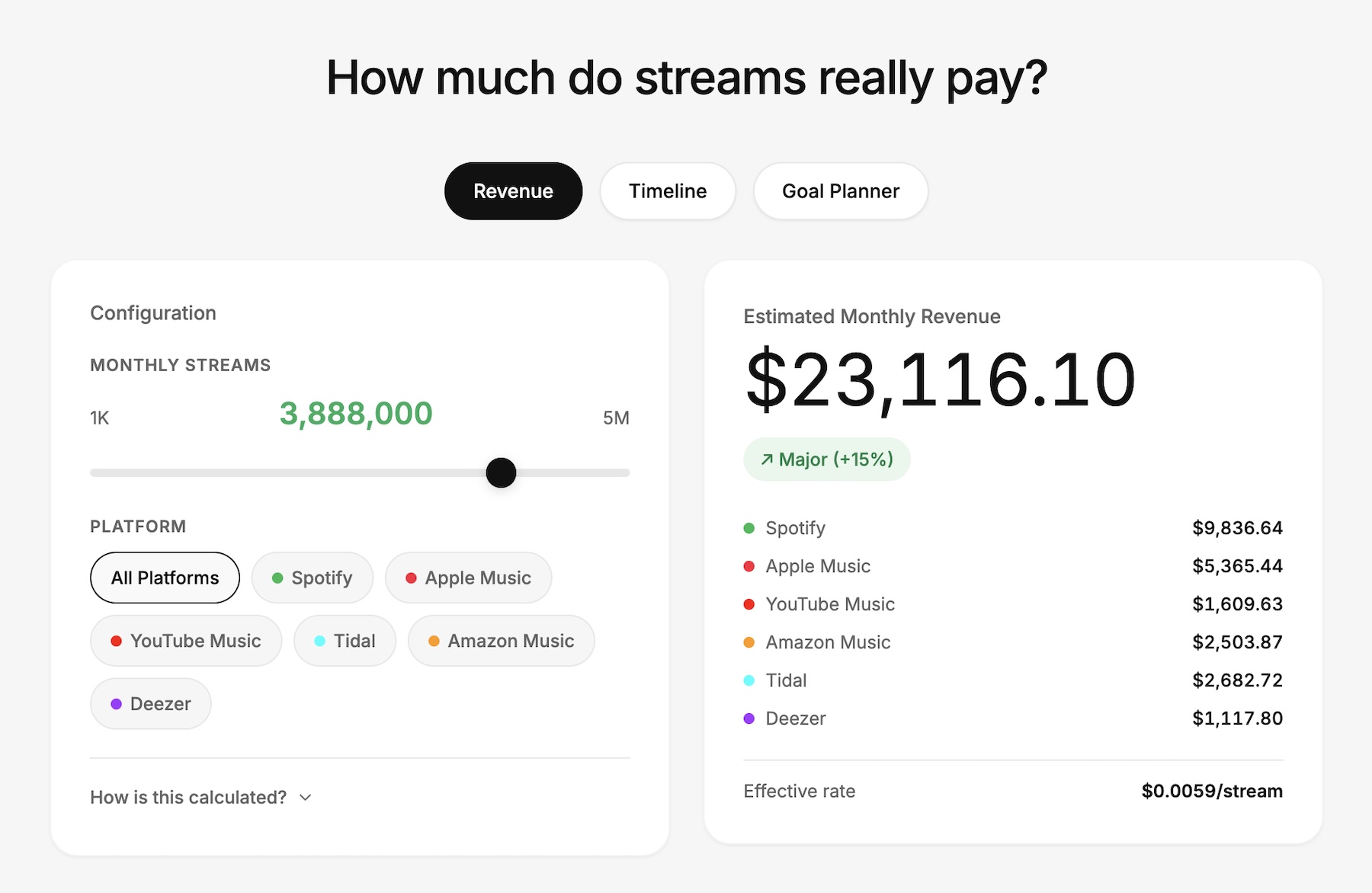
1. What might these streams earn?
The revenue calculator uses platform estimates and adjustable assumptions instead of presenting one rate as a promise. Its result is a planning range, not a royalty statement.
2. When might the money arrive?
The payout timeline shows the steps between a stream and a distributor payment. The dates are based on published distributor information and our reporting experience. Actual timing can still change.
3. How many streams might support a revenue goal?
The reverse calculator starts with a monthly target and estimates the required streams across several platforms. This is useful for planning, but it cannot know the exact countries, subscription mix, rights, or distributor terms behind future listening.
What the calculator cannot know
Our first-party data comes from one catalog, one distributor, and a particular mix of listeners. For services where we did not have enough direct data, the calculator uses published industry estimates.
It cannot predict:
- the exact audience mix of a future release;
- changes to platform royalty policies;
- label, publisher, or collaborator splits;
- taxes, recoupment, or every distributor fee;
- whether all reported streams will qualify for payment.
No public calculator can know all of that from a stream count alone.
A simple check for your own catalog
Take one complete royalty period. Divide the amount reported for a platform by the matching eligible streams from that same period.
Then repeat the calculation for several months.
If the effective amount moves, do not force one universal rate onto the catalog. Use a range, keep the reporting delay visible, and update the estimate when new statements arrive.
Try the calculator — and treat the result as a planning tool, not a promise from a streaming service.